


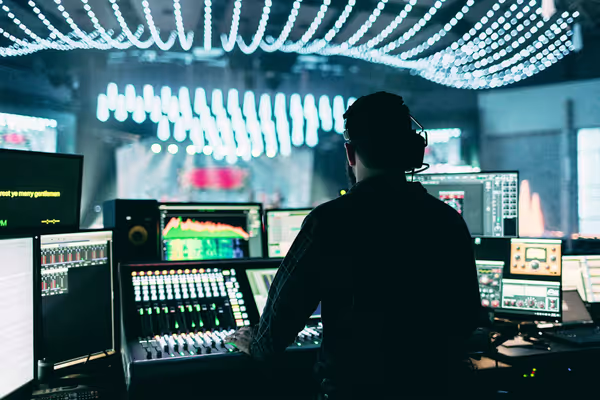
Music writing becomes more useful when it starts with a simple question: what are we actually hearing, and why does it matter? The Studio as an Instrument approaches that question through craft, looking closely at microphones, takes, arrangement, tape, digital editing, mixing, and the decisions made before a record reaches listeners. The subject is not treated as a trend or a list of recommendations. Instead, it is a way to understand how musical choices become part of everyday life. A song can be technically modest and still alter the atmosphere of a room. A recording made decades ago can suddenly sound urgent because the listener has changed. A small performance can become important because it gives strangers a reason to occupy the same space. Those experiences are difficult to reduce to numbers, yet they are central to music culture.
The first useful distinction is between music as an object and music as an experience. A file, record, score, instrument, or ticket is a physical or digital thing; the meaning arrives through context. Who made it? Where was it heard? What else was happening around it? What expectations did the listener bring? In recording culture, those questions often reveal more than technical specifications alone. They also explain why two people can hear the same arrangement and leave with completely different memories. The difference is not a failure of listening. It is evidence that music operates as a meeting point between sound, place, identity, attention, and time.
One reason this subject deserves a slower look is that modern listening has become unusually abundant. Almost any style can be reached within seconds, and almost any artist can appear beside thousands of alternatives. Abundance is liberating, but it can also make individual records feel interchangeable. The answer is not to reject technology or pretend that older listening habits were automatically better. It is to develop stronger habits of attention. When listeners give a piece enough time to reveal its internal logic, small details begin to matter: a breath before a vocal phrase, a drummer leaving space after a hit, a bass note arriving slightly late, or an instrument sitting at the edge of the stereo field.

Listening Beyond the Surface
That attention changes the way creators are heard as well. Musicians and producers are not simply delivering content into a neutral pipeline. They are making decisions about texture, density, pacing, repetition, silence, and emphasis. Those choices create an invitation for the listener. A sparse arrangement asks for patience. A crowded mix rewards repeated listening. A live ensemble can create tension because no performance is perfectly identical to the last one. The most compelling work often leaves enough room for the listener to participate rather than explaining every emotional response in advance.
Technology has complicated this relationship without making it less human. New tools can make recording, editing, synthesis, distribution, and collaboration easier, but tools do not decide what deserves attention. The interesting question is how a creator uses a limitation or possibility. A cheap microphone can become part of an aesthetic. A sampler can become an instrument rather than a shortcut. A laptop can function as a complete studio, while a room full of expensive equipment can still produce an uninspired recording. Craft begins when the available tools are connected to a clear intention.
Place matters just as much. Music scenes grow around rehearsal rooms, record shops, cafés, clubs, community halls, studios, radio stations, and other spaces where people encounter one another repeatedly. These locations create informal knowledge. A listener learns which local bands are experimenting, which engineer understands a particular room, which record shop stocks unusual releases, and which promoter gives new artists a fair chance. None of that information needs to appear in a formal database. It travels through conversation, attendance, recommendation, and trust.
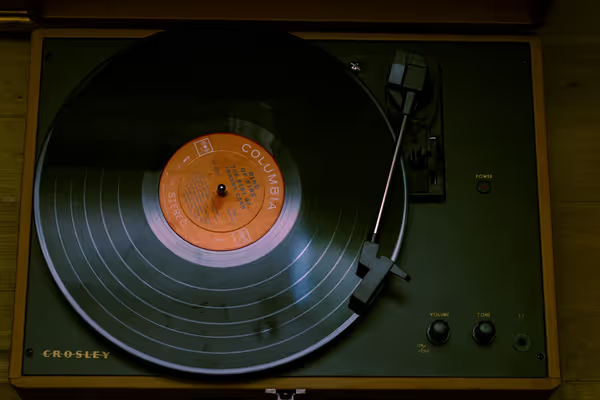
History is useful here because many supposedly new ideas are variations on older experiments. Changes in recording formats have repeatedly altered the length, structure, and economics of music. Radio changed how songs were introduced to strangers. The cassette encouraged personal compilation. The compact disc changed expectations around fidelity and portability. Digital distribution removed physical limits from catalogs. Streaming made access almost frictionless. Each change solved some problems while creating others. The lesson is not that one era was correct. It is that music culture constantly adapts its practices to the tools available.

The most lasting musical experiences are rarely the loudest; they are the ones that change the way we listen.
Context, Craft, and the Listener
Artists also build meaning through communities rather than isolation. Even a solitary songwriter depends on a chain of listeners, collaborators, engineers, designers, distributors, venues, programmers, editors, and friends. The visible artist is only one part of a larger ecosystem. Paying attention to that ecosystem gives a richer account of why certain records survive. It also makes room for people whose work is usually hidden: the sound engineer checking a cable before doors open, the archivist preserving a master tape, the independent label owner answering late-night emails, or the volunteer keeping a small venue alive.
There is a practical lesson for listeners in all of this: curiosity is more valuable than completion. A playlist does not need to be finished. An album does not need to be rated after one pass. A genre does not need to be mastered before it can be enjoyed. Follow one sound into another. Read the credits. Listen to the producer's other work. Compare a live recording with a studio version. Return to a song after a month. These small habits turn passive consumption into active discovery and make a large catalog feel less overwhelming.
Criticism benefits from the same patience. Good criticism does not merely announce whether something is good or bad. It describes what the work is trying to do, identifies the choices that support or weaken that aim, and gives readers enough detail to make their own judgment. That approach is especially important in music because taste is personal. A difficult record can be valuable without being pleasurable. A technically impressive performance can still feel emotionally distant. A simple song can become unforgettable through timing, voice, and context.
The most durable musical experiences often combine precision with openness. There may be a carefully planned arrangement underneath a performance that feels spontaneous. A producer may spend hours shaping a sound that ultimately appears effortless. A songwriter may rewrite a chorus until it feels like it arrived naturally. Listeners rarely hear the entire process, and perhaps they should not. Part of the pleasure is sensing that a finished work contains decisions without feeling burdened by them. Craft disappears into expression when the two are balanced well.
A Culture Built Through Attention
Looking ahead, the central challenge is not whether music will survive another technological shift. It will. The more interesting question is what kinds of attention new tools will encourage. Faster discovery can coexist with deeper listening. More accessible production can coexist with demanding craft. Artificially generated or algorithmically assembled sounds can exist alongside instruments, voices, and live communities. The human task remains interpretation: deciding what feels meaningful, what deserves time, and which musical relationships are worth carrying forward.
In the end, the studio as an instrument is less about protecting a particular format than about protecting the conditions in which music can mean something. Those conditions include time, attention, curiosity, skilled people, welcoming spaces, and the freedom to encounter sounds without immediately turning them into products. For listeners, that may mean choosing one record and hearing it without interruption. For artists, it may mean leaving space for uncertainty. For publishers and communities, it means telling the stories behind the sounds rather than treating every release as disposable news. Music remains powerful because it can be both designed and discovered. The better we understand that tension, the richer our listening becomes.
Another useful way to approach the studio as an instrument is to notice what disappears when music is discussed only as a product. Release dates, genre labels, streaming counts, equipment lists, and short reviews can be useful reference points, but they do not explain the full experience. Music is also a practice of choosing, remembering, comparing, gathering, and returning. A listener brings a personal history to a recording, while a performer brings a physical history to an instrument. A venue carries the memory of previous audiences, and a studio carries the accumulated habits of everyone who has worked there. These layers are invisible in a thumbnail, yet they often determine whether a musical moment feels ordinary or significant.
That is why the healthiest music culture makes room for both expertise and discovery. Specialists can explain technique, history, acoustics, production, or performance practice, while newcomers can notice details that experienced listeners have stopped questioning. Neither perspective needs to replace the other. The strongest communities allow knowledge to circulate without turning curiosity into a test. In practical terms, that means keeping conversations open, supporting places where artists can experiment, preserving recordings and documents, and making criticism specific enough to be useful without pretending that taste can be settled permanently. The reward is a richer culture in which music remains something people can encounter, discuss, reinterpret, and carry into the future.

Comments